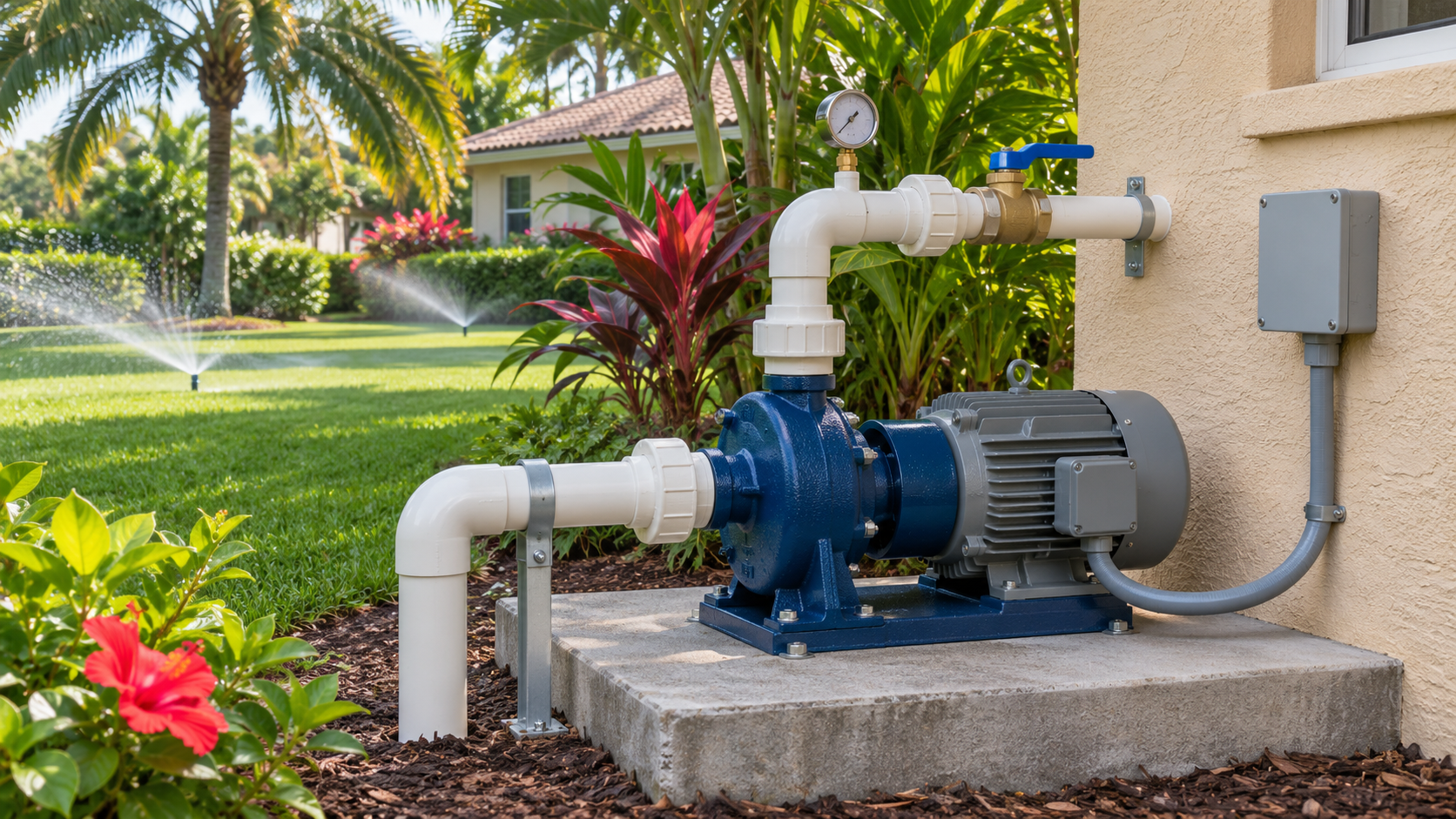
A dependable irrigation system starts with equipment that matches your landscape and water supply. Even well-placed sprinklers can struggle when the pump cannot deliver the required flow and pressure. Choosing a larger motor without checking the system can create additional problems.
1. Identify Your Water Source
Your water source helps determine which pumping arrangement is appropriate. A well, pond, or storage tank presents different conditions, including water depth, available supply, and potential debris.
For irrigation pump selection Florida properties require, document where water comes from and how its level changes during operation. The distance between the pump and water surface matters, especially when an aboveground pump must lift water.
UF/IFAS explains that falling source-water levels can reduce pump output. A selection based only on conditions during the rainy season may overlook more demanding operating conditions.
2. Confirm Whether You Need a Pump
Some homeowners assume every irrigation system needs a separate pump. However, an existing pressurized supply may already provide adequate performance.
Before making an irrigation pump selection Florida purchase, have the available flow and operating pressure evaluated. If sprinkler coverage recently declined, investigate leaks, clogged components, valve restrictions, or supply changes before adding equipment.
Describe when the problem occurs. Does every zone struggle, or only one? Did performance change after new sprinklers were installed? These details help distinguish a pumping limitation from a problem elsewhere in the system.
3. Calculate Each Zone’s Water Demand
Flow describes how much water moves through the system, commonly measured in gallons per minute. Each sprinkler or emitter contributes to the demand of its operating zone.
Reliable irrigation pump selection Florida planning requires calculating the demand of each zone that operates simultaneously. For example, six sprinklers rated at two gallons per minute create a nominal demand of twelve gallons per minute under their specified conditions.
The pump must support the required flow at the necessary pressure. UF/IFAS recommends designing irrigation around available water, allowable pump flow, and source pressure.
4. Understand Pressure and Total Dynamic Head
Pressure helps water move through pipes and operate irrigation devices. However, a pump must also overcome elevation differences and friction losses through piping, valves, and other components.
For irrigation pump selection Florida homeowners can discuss with a contractor, ask for the required flow and total dynamic head. Total dynamic head expresses the system’s overall pumping requirement as an equivalent height of water.
A pump’s performance curve shows the relationship between flow and head. The appropriate model must meet both requirements together; its advertised maximum flow alone does not establish suitability.
5. Compare Pump Types
Aboveground centrifugal pumps are used in many irrigation applications. Depending on the source and installation conditions, a submersible pumping arrangement may be more appropriate.
During irrigation pump selection Florida evaluations, compare equipment intended for the actual application. Consider source depth, suction conditions, required pressure, and service access. UF/IFAS describes several dynamic pump configurations and emphasizes how installation conditions influence their performance.
Also clarify priming requirements. “Self-priming” does not necessarily mean a pump can start dry. For example, Pentair specifies initial housing filling and a check or foot valve for certain self-priming sprinkler pumps. Follow the selected model’s instructions.
6. Look Beyond Horsepower
Horsepower describes motor power, but it does not tell you exactly how a pump will perform on your property. Pumps with similar horsepower can have different performance characteristics.
A sound irrigation pump selection Florida decision compares the required operating point with the manufacturer’s performance curve. Ask where the proposed pump will operate and whether that point falls within its recommended operating range.
Avoid choosing extra horsepower simply as insurance against future problems. NSW agricultural guidance recommends matching the pump, motor, and piping for efficient operation, which can help control power costs.
7. Consider Water Quality
Water quality affects equipment selection and maintenance planning. Surface-water sources may introduce sediment, while other supplies may present different filtration or treatment needs.
Include water quality in your irrigation pump selection Florida discussion. Ask whether the proposed intake, pump, and filtration arrangement suit the source. NC State Extension notes that sediment drawn from surface water can accelerate pump wear, particularly when water levels become low.
Explain any history of sand, staining, clogged filters, or repeated emitter blockages. These observations help a professional identify what needs investigation before recommending equipment.
8. Check Electrical and Controller Compatibility
The pump must work with your electrical supply and irrigation controls. Confirm the proposed motor’s voltage, electrical requirements, and starting arrangement before installation.
Complete irrigation pump selection Florida planning should also address how the controller starts and stops the pump. Ask whether the existing pump-start relay and protective equipment are appropriate for the replacement.
Have qualified professionals handle electrical connections and equipment compatibility. Keep equipment labels and manuals accessible, and request a clear explanation of normal operation. Knowing how the system should behave makes later changes easier to recognize.
9. Compare Installation and Ownership Costs
The purchase price is only part of the project. Installation may involve intake changes, piping repairs, electrical work, controls, testing, and access improvements.
When comparing irrigation pump selection Florida estimates, request an itemized scope. Ask what existing components will remain and how their condition was assessed. Review maintenance requirements, warranty terms, and replacement-part availability.
Discuss planned landscape expansions now. Adding irrigation zones does not automatically require operating them together, so future needs should be evaluated through a proposed design rather than an assumed increase in pump size.
Plan Your Pump Selection With Bartram Outdoor
Effective irrigation pump selection Florida homeowners can feel confident about starting with measurements and a clear understanding of the property. Water source, zone demand, pressure requirements, controls, and installation conditions should guide the decision.
At Bartram Outdoor in Palm Beach, Florida, we help homeowners understand irrigation concerns and plan practical improvements. Contact our team to discuss your existing system, watering needs, and the next steps toward selecting appropriate pumping equipment.